Auxiliary Kit Buyers Forget: Pumps, Valves and Heat Exchangers
Tanks are the part of a brewery everybody photographs, and the auxiliary kit is the part that decides how the day actually runs. A published example bill of materials for a complete 10 BBL system lists two pumps, 304 stainless wort pipes, a 10 m² plate heat exchanger, cooling valves, a CIP unit and a control cabinet alongside the vessels — roughly a third of the line items, none of them glamorous. Hermann has supplied brewing equipment for 23 years, and the questions that arrive after commissioning are almost always about these pieces.
Key takeaways
- The published example list for a complete 10 BBL system includes a 3 m³ wort pump and hot water pump, 304 wort pipes and a 10 m² plate heat exchanger.
- Pumps, seals and gaskets are the wear items, so their spares list matters as much as their specifications.
- Undersized cooling shows up as long knockouts and slow fermentations, not as a dramatic failure.
- Every shipment passes five inspection steps, and a checking list arrives with the crates so the auxiliary parts can be reconciled before installation.
The auxiliary list inside a complete package
A complete brewery is not a set of tanks with a few pipes between them. The example bill of materials published for a 10 BBL system reads like this: a 10 BBL mash and lauter tun, a 10 BBL kettle and whirlpool tun heated by steam, a 20 BBL hot water tank, a 3 m³ wort pump and a hot water pump, stainless steel 304 wort pipes, a 10 m² plate heat exchanger, an operation platform, four 10 BBL fermentation tanks, a glycol water tank, a chiller, cooling pipes and valves, a CIP unit, and a control cabinet with a semi-automatic control system.
Read that list again and notice the ratio. Vessels occupy the first lines; the rest is machinery that moves liquid, transfers heat or cleans. Buyers who spend the whole budget on vessel size and leave the auxiliary scope thin end up with a plant that brews slowly, cools badly and takes longer to clean.
Pumps and the parts that wear first
A wort pump and a hot water pump do different jobs and should be specified separately rather than as "a pump". The wort side sees hot, sugary liquid and needs a seal that tolerates it; the hot water side runs at temperature for long periods. The published example sizes both at 3 m³ per hour, which is a sane match for a 10 BBL brewhouse and gives enough headroom to move liquid through a heat exchanger and up into a vessel without waiting.
Ask what the spare-parts list contains before delivery: mechanical seals, gaskets, impellers and a spare valve kit are the items that stop production when they fail on a Saturday. Because the published warranty runs 6 years on tank accessories and electronic components against manufacturing defects from the factory, used within scope, it is worth knowing which parts fall inside that wording and which are simply consumables you will buy again.
Pipework, valves and the 10 m² heat exchanger
Stainless steel 304 wort pipes and the valves that sit on them are specified by diameter and route, and the route matters more than the diameter. Long runs lose heat, trap liquid and make cleaning harder, so the drawing should keep the kettle, the exchanger and the fermentation vessel as close together as the room allows.
The plate heat exchanger is the piece buyers most often under-size. A 10 m² unit is the published example for a 10 BBL system, and it is sized against the batch volume, the knockout time and the cooling water temperature you can actually supply. If your water arrives warmer than the design assumption, the exchanger will need longer, or the fermentation tanks will be filled warmer than intended.
Behind all of that sits the CIP unit and the control cabinet, the two items most often treated as accessories. A clean-in-place loop has to reach every vessel, every pipe run and the exchanger itself; if one branch is missed, the cleaning routine quietly reverts to a hose and a ladder. The cabinet sets how much of the day runs automatically, and the published example for a 10 BBL system pairs the vessel set with a semi-automatic control system. Any brewery expecting a second brewhouse later should say so at drawing stage, because cabinet capacity and spare loop connections are far easier to allow for before the pipework is fixed.
| Item | Why it gets overlooked | What to pin down |
|---|---|---|
| Wort and hot water pumps | Listed as one line, treated as one part | Flow, head, seal material, spare seals on the shelf |
| Stainless 304 wort pipes | Looks like plumbing rather than equipment | Route length, slope, drain points, cleaning access |
| Plate heat exchanger | Sized on a cold-water assumption | 10 m² example area against your real water temperature |
| Cooling pipes and valves | Hidden behind the tanks | Access for maintenance and a valve schedule you can read |
| CIP unit and control cabinet | Treated as an add-on | Loop coverage, chemical dosing, control level for the operators |
Worked example: cooling a 1,000 litre knockout
Example, with assumptions stated. Take 1,000 litres of wort leaving the kettle at 95 °C and going into a fermentation tank at 20 °C. The drop is 95 − 20 = 75 K. Treating wort as water with a specific heat of about 4.0 kJ per kilogram per kelvin, the heat to remove is 1,000 × 4.0 × 75 = 300,000 kJ, which is 300 MJ. Spread that across a 45-minute knockout, or 45 × 60 = 2,700 seconds, and the average cooling demand is 300,000 ÷ 2,700 ≈ 111 kW.
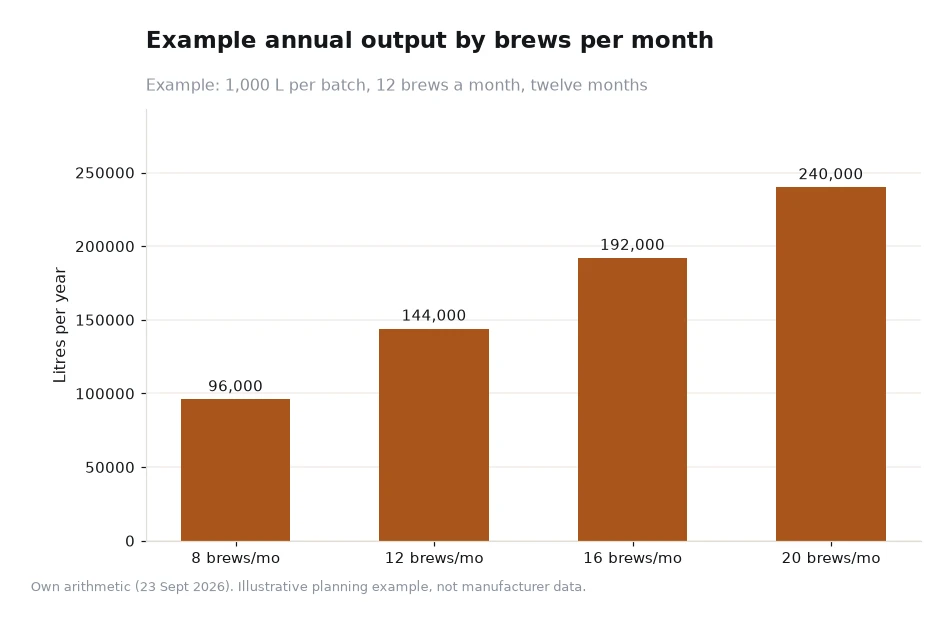
Now the volume side. At 1,000 litres per batch, eight brews a month is 8 × 1,000 × 12 = 96,000 litres a year, twelve brews gives 12 × 1,000 × 12 = 144,000 litres, sixteen gives 192,000 litres and twenty gives 20 × 1,000 × 12 = 240,000 litres — the four bars in the chart below. Neither set of figures is a promise about output; they exist to show how quickly a small shortfall in cooling becomes a scheduling problem.
Frequently asked questions
What auxiliary equipment is included in a complete brewery package?
The published example for a 10 BBL system includes a wort pump and a hot water pump, stainless steel 304 wort pipes, a 10 m² plate heat exchanger, an operation platform, a glycol tank, a chiller, cooling pipes and valves, a CIP unit and a control cabinet.
How long should cooling a batch take?
That depends on the exchanger area, the batch volume and the temperature of your cooling water. As an example, cooling 1,000 litres from 95 °C to 20 °C is 300 MJ of heat, which is about 111 kW over a 45-minute knockout.
Checking the auxiliary scope before you sign
Before the order is confirmed, walk the example bill of materials line by line and mark which items you are buying and which you intend to source locally. Pumps, valves, gaskets and the control cabinet are the items where a local substitution looks cheaper at the start and complicates the warranty conversation later.
For a first brewery, the most useful preparation is a single list: batch volume, water temperature, steam or power supply, floor layout and the cleaning routine you expect. That list is also what a supplier needs in order to quote a micro brewery equipment package with the auxiliary items priced in, rather than leaving pumps and exchangers to be found locally at the last minute. The brewing house pages show how the hot side is configured, the main site carries the wider range of brewery equipment, and the company background sits on the about us page. Send that list with your enquiry and the auxiliary scope comes back sized to your building rather than to a template.
Published figures come from the manufacturer's own website, read 23 Sept 2026: the example bill of materials for a complete 10 BBL system, the five inspection steps on every shipment, the wooden-box packing with a checking list, the 6-year warranty on tank accessories and electronic components against manufacturing defects from the factory, used within scope, and the 90–150 day deposit-to-door delivery window. The cooling calculation and the annual output bars are this article's own labelled examples.[1]