Expectations for Text-Only Adult AI
Text-only means exactly what it says, and setting expectations accordingly is the difference between a service that disappoints and one that works well. The platform's compliance statement describes its content as AI-generated text that depicts no real person, and no images or video are produced by the site. What remains is a written medium, where quality varies with the setup a creator wrote and the context a thread carries — a spread visible in counter ratios from about 0.0175% to 0.0526%.

Key takeaways
- Text is the whole product here: AI-generated writing, with no real people depicted and no images or video produced by the site.
- What varies is the writing — a card with a described situation reads differently from one with a name and a label set.
- Longer threads change the experience more than any setting, because context is what a written companion accumulates.
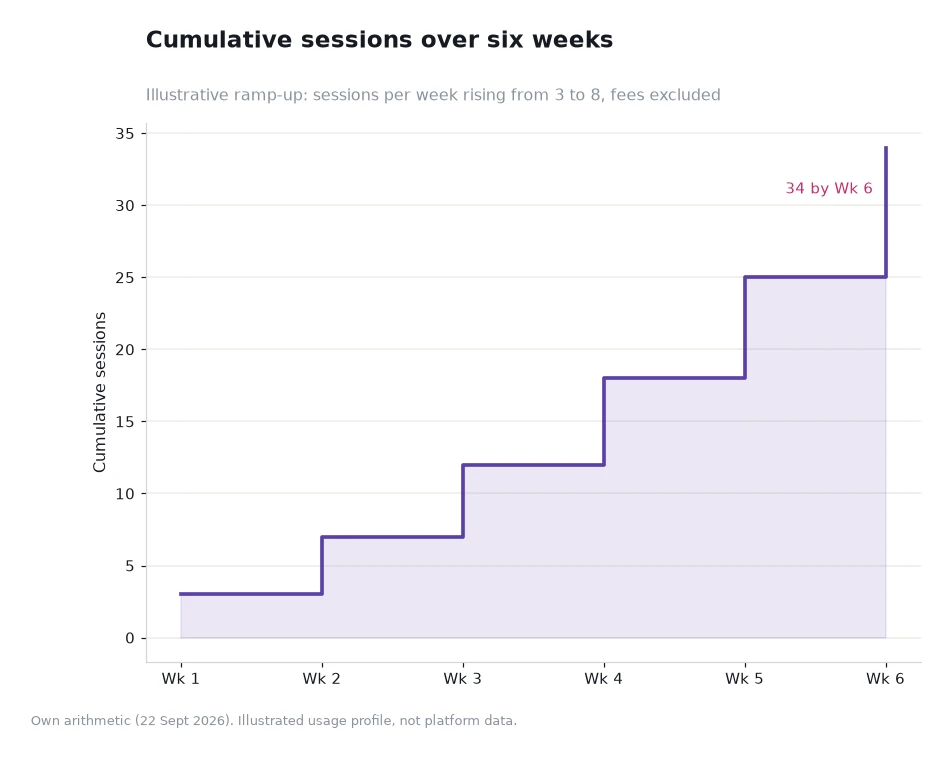
- An illustrated six-week ramp of 3, 7, 12, 18, 25 and 34 cumulative sessions reaches 34, enough to test a handful of cards properly.
What text-only delivers well
Written conversation is good at three things. It holds a role consistently once the role has been established, it accumulates detail over a long thread, and it lets the reader set the pace. Those strengths are easy to underestimate until you have run a fifty-message exchange: the character stays recognisably itself, and the situation you described in the second message is still part of the scene much later.
It also suits readers who prefer to write. A text-only companion gives back what it is given, so a reader who enjoys supplying detail and inventing situations gets more from the medium than one who wants to be entertained passively.
There is a craft element that text rewards as well. Describing a room, giving a character a reason to be present, and answering your own rhetorical questions gives a session a shape; a reader who writes a little more than they speak notices the difference within the first ten messages, while a reader who writes one line gets back roughly what they put in.
Expectations are worth stating in that light. A Porn Chat AI service is judged on writing and continuity, which are the two things a reader can also influence directly, rather than on production values a written medium was never going to supply. Set the bar there and the medium stops feeling narrow.
What text-only does not deliver
It does not deliver pictures, sound or motion, and it is not meant to. No real person is depicted anywhere in the catalogue, and the site does not produce images or video of people. Expecting a media experience from a text service is the most common source of disappointment, and reading the compliance page first removes it in under a minute.
It also does not deliver unlimited options. The platform publishes filters for Filtered, Unfiltered and 18+, and states that some limitations apply in accordance with its content and community guidelines. Those limits are part of the terms of use rather than a hidden rule, which means an expectation set before a session starts can be accurate rather than hopeful.
| Expectation | What a text service does | Where that is stated | Mismatch it prevents |
|---|---|---|---|
| Medium | Written conversation only | 2257 compliance statement | Looking for images or video |
| Continuity | Recalled interactions and remembered preferences | Product copy on the chat pages | Assuming every session starts fresh |
| Variation | Replies differ between attempts | Behaviour of adaptive responses | Expecting a fixed script |
| Boundary | Published guidelines apply | FAQ and policy pages | Assuming no limits exist |
| Quality | Depends on the creator's setup | Visible in each card description | Blaming the medium for a thin card |
Worked example: what 34 sessions buys
The chart alongside tracks cumulative sessions across six illustrative weeks: three in week one, then four, five, six, seven and nine. The running totals are 3, 7, 12, 18, 25 and 34, since 3 + 4 + 5 + 6 + 7 + 9 = 34.
Spend that budget on a realistic plan. Week one samples six cards in three sessions, at two cards per session, and keeps two. Weeks two to six then run twelve longer sessions across those two cards, with the remaining sessions used to open one new card a fortnight. By week six you have sampled eight cards, kept two or three, and given each keeper roughly a dozen conversations.
The session counts and the two-cards-per-session sampling rate are illustrative assumptions, not platform data. The arithmetic is there to show that an expected-quality assessment needs a dozen conversations per card, and that six weeks at this ramp supplies exactly that without any heroic session lengths.
Checking expectations against the page
Three documents answer nearly every expectation question. The compliance statement settles what the content is; the product copy on the chat page states how responses behave and what privacy means here; and the policy pages show what happens when something needs reporting. Reading them takes less time than a single session and removes the guesswork permanently.
For a reader who wants the operator's own framing of the medium, the 2257 compliance statement is the most precise source, and the AI sex chat overview spells out the adaptation and continuity wording in the same terms the product uses. Set expectations against those two, and what remains is a manageable question about which cards are well written — which is exactly the question the ai porn chat catalogue exists to let you answer.
A last expectation is about patience rather than capability. A written character that has been running for a hundred messages will read very differently from the same character at message ten, and readers who give a card two or three sessions before judging it are the ones who end up with a dependable list.
Two smaller expectations follow from that. Writing quality varies by creator rather than by platform, so the honest comparison is between cards rather than between services. And a session is not valuable in proportion to its length: twelve well-supplied messages usually produce more than sixty thin ones.
Frequently asked questions
Is there any visual content on the platform?
No. The content is described as AI-generated text, no real person is depicted, and the site does not produce images or video of people.
Why do two sessions with the same card feel different?
Because replies are generated rather than retrieved, so the wording varies while the character's role stays the same.
How long before a card shows what it can do?
About a dozen conversations is a fair trial. Below that you are still testing the opening description rather than the character.
Does text-only mean low effort from the reader?
The opposite. A written medium returns what it receives, so supplying one concrete detail per message improves the reply more than any setting change.
Expect the medium, then judge the card
Text-only is a description of the medium, not a limitation of it. Accept that the experience is written, check the published documents once, and spend the rest of your attention on card quality — which is the only variable you can really influence. A reader who expects writing and evaluates setups will find a great deal to work with; one who expects pictures will be disappointed within a minute.
Data and sources: the 2257 compliance statement, product copy and published policies on the Crushon site[1], read 22 Sept 2026. The six-week session ramp and sampling rates are illustrated assumptions, not platform data. Not suitable reading for anyone under 18.