Road Trips in an EV: Planning the Charging Stops
The mistake most people make on their first electric road trip is planning around chargers instead of distances. The published figures make the opposite approach possible: the New G6 carries up to 525 km of WLTP range and takes 12 minutes to go from 10% to 80% state of charge. Plan a stop every few hundred kilometres, add a few minutes of overhead per stop, and the day stops feeling like a logistics exercise.
Key takeaways
- Published range is up to 525 km WLTP for the New G6 and up to 580 km for the X9, and both depend on conditions.
- A 10–80% top-up is published at 12 minutes on the 5C battery; the charge flap is on the right rear quarter panel.
- XPENG vehicles work with most public Type 2 AC and CCS2 DC fast chargers, and some Tesla Supercharger sites in Australia are open to non-Tesla CCS2 vehicles.
- Touring lifts annual distance, and at 25,000 km a year the published service interval produces six events in five years rather than five.
Start with the published numbers
Four figures do most of the work in trip planning. The New G6 is published with up to 525 km of WLTP range; the seven-seat X9 with up to 580 km. Both take 10–80% state of charge in 12 minutes on the 5C battery, and the G6's platform is described on the Australian site as a Full-Domain 800V High-Voltage SiC Platform with 5C supercharging. Separately, up to 427 km of charge added in 15 minutes comes from XPENG's internal tests of the G6 RWD Long Range, so treat it as specific to that variant and that test.
Notice that none of these numbers is a promise about your trip. WLTP depends on conditions, and conditions on a road trip include a loaded boot, a roof rack, a headwind, cold morning air and a highway speed that sits above the test cycle. Plan with a margin and the published figures become useful anchors rather than disappointments.
Where to stop, and what to check before you leave
Compatibility is the first question. XPENG vehicles are compatible with most public Type 2 AC and CCS2 DC fast chargers, so a stop is usually a matter of finding a bay with the right plug rather than worrying whether the car will charge at all. The second question is payment, because a charger that requires a specific app is a problem if you have not installed it, and the simplest fix is to set up two or three networks before you leave home.
There is one published caveat worth carrying with you: some Tesla Supercharger sites in Australia are open to non-Tesla CCS2 vehicles, and the manufacturer's guidance is to check the Tesla app for site compatibility, because not all sites support non-Tesla cars. Naming that in advance saves the awkward moment of arriving at a site that will not talk to your car. Before any of it, know where your charge flap is: it sits on the right rear quarter panel, and you press the top-left of the flap before connecting the cable.
Trip planning inputs, published and assumed
| Input | Value and status |
|---|---|
| Range, New G6 | Up to 525 km WLTP, published |
| Range, X9 | Up to 580 km WLTP, published |
| Fast-charge window | 10–80% in 12 minutes, published |
| Stop spacing | Every 300 km, assumption for this example |
| Overhead per stop | About 8 minutes, assumption for this example |
Write the plan as distances
Begin with the day's total, then divide it into legs of a few hundred kilometres — 300 km is the figure used as an assumption in this article's example, not a published rule. Each leg becomes a charging stop. That is all the planning most trips need, and it has an advantage over charger-led planning: if a site is busy when you arrive, you already know where the next leg takes you.
Decide in advance whether you will charge at home before leaving and, if the trip starts early, whether a top-up near the edge of the city is worth the detour. Leaving with a full battery on an overnight home tariff is the lowest-cost plan by a wide margin, and it removes one stop from the day before the day has started.
Worked example: a 1,200 km trip across two days
Assume a 1,200 km route split as 650 km on day one and 550 km on day two. Assume stops every 300 km, each using the published 12-minute 10–80% window, with 8 minutes of overhead per stop for the detour, plugging in and paying. Assume energy use of 19 kWh per 100 km, higher than the flat-road figure because the car is loaded, and electricity at $0.30 per kWh.
Stops and charging time. Day one: 650 km ÷ 300 km = 2.2, so three stops. Day two: 550 ÷ 300 = 1.8, so two stops. Total stops across the trip: 3 + 2 = 5. Charging time: 5 × 12 minutes = 60 minutes. Overheads: 5 × 8 minutes = 40 minutes. Total time devoted to charging across the two days: 60 + 40 = 100 minutes, which is under an hour a day and is usually spent buying coffee anyway.
Energy and cost. 1,200 km ÷ 100 = 12 blocks of 100 km. 12 × 19 kWh = 228 kWh purchased. 228 × $0.30 = $68.40 for the whole trip, or $34.20 a day. On the same assumptions in a petrol car at 8.0 L per 100 km and $1.90 per litre the fuel would be 12 × 8.0 = 96 L, and 96 × $1.90 = $182.40, a difference of $114 for the trip — worth more than the accommodation on most two-day drives.
The service side of a touring habit
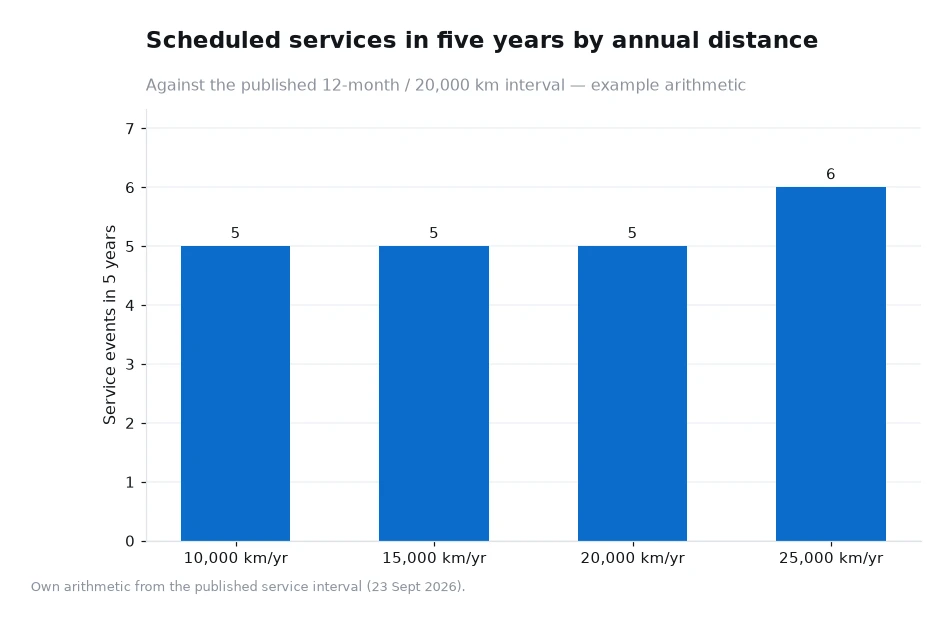
Road trips change one more thing that is easy to forget. The published service interval is every 12 months or 20,000 km, whichever comes first, so a car that spends its weekends touring crosses the distance trigger sooner. At an assumed 15,000 km a year the interval produces five service events across five years. At 25,000 km a year the odometer reaches 20,000 km before the twelfth month, and the five-year total becomes six events. The chart below plots those four annual-distance scenarios.
The practical implication is calendar management rather than cost: book the service before a long trip rather than after, and keep the record with the car. If something does go wrong on the road, roadside assistance is published for 7 years from first registration, with 24/7 coverage of the majority of Australia on 1800 255 494 — the roadside assistance page carries the details, and the charging page covers home charging and public compatibility.
Frequently asked questions
How often will I need to charge on a long drive?
Using the assumption in this article, one stop every few hundred kilometres, which on a 1,200 km trip across two days means about five stops of 12 minutes each plus roughly 8 minutes of overhead per stop.
Will an electric car cope with a loaded family road trip?
It will, with planning: load, roof racks and highway speed all reduce real range below the published WLTP figure of up to 525 km for the New G6, so leave a margin and plan a stop before the battery is low.
Before you leave the driveway
Charge at home overnight, install the two charging apps you are most likely to need, put the roadside assistance number in your phone, and write the day's distances on a note rather than a list of charger names. Then pack the boot with the cable where you can reach it without unpacking the luggage.
The first long drive in an electric car is usually the one that changes people's minds about them, and it does so for a boring reason: the stops turn out to be shorter than expected and the day costs less than fuel would have. Plan the distances, keep a margin, and the rest takes care of itself. For electric cars australia owners who tour regularly, that plan is mostly arithmetic: distance divided into legs, plus a few minutes at each stop.
Range, charging, service and roadside figures come from the manufacturer's Australian site at xpeng.com/au, read 23 Sept 2026, including the footnote that the 427 km figure is from internal tests of the G6 RWD Long Range and that WLTP figures depend on conditions. The 300 km stop spacing, 8-minute overhead, 19 kWh per 100 km, $0.30 per kWh, 8.0 L per 100 km and $1.90 per litre inputs are illustrative assumptions, not manufacturer data.[1]