Particleboard sourcing for furniture begins with the finished component, not a catalog grade. A cabinet side, shelf, drawer bottom, and desk top may need different thickness, surface, edge treatment, fastener performance, and service conditions. Buyers should translate the design into a complete panel specification and require evidence for the exact board and factory offered.
Key takeaways
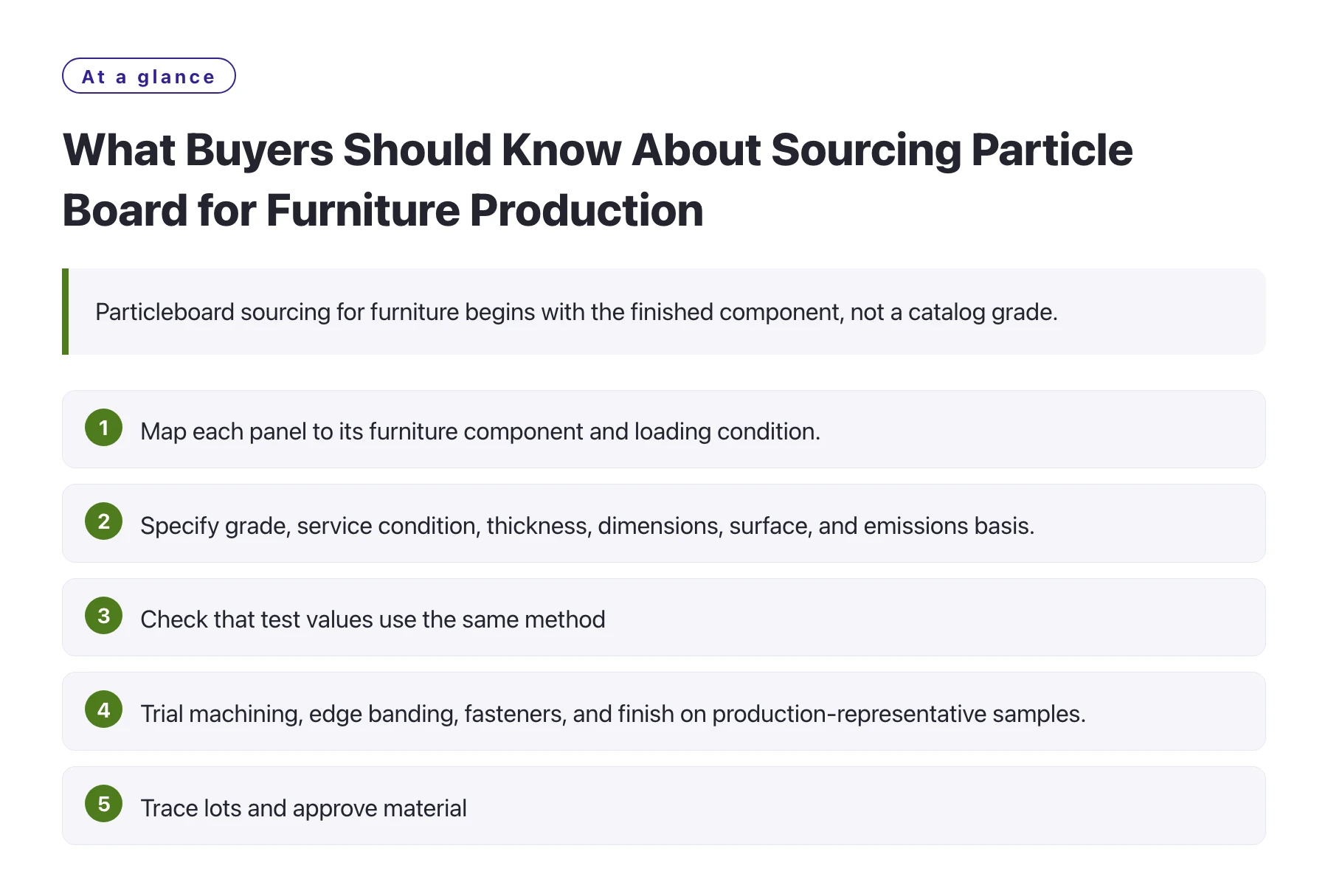
- Map each panel to its furniture component and loading condition.
- Specify grade, service condition, thickness, dimensions, surface, and emissions basis.
- Check that test values use the same method, units, and specimen conditioning.
- Trial machining, edge banding, fasteners, and finish on production-representative samples.
- Trace lots and approve material, plant, or process changes before production.
A consistent document review ties each claim and report to one controlled product, manufacturer, revision, and market.
1. Map the board to the furniture part
List every panel part with finished dimensions, thickness, support span, load, fastening method, and exposure. A vertical cabinet side, long shelf, drawer bottom, and work surface do not share the same design demands. Identify whether the panel is structural, decorative, or a substrate for a separate finish.
ISO 16893:2016 classifies particleboard for general-purpose, furniture, load-bearing, and heavy-duty load-bearing applications with service conditions. Its classification values are not characteristic design values. Have the designer establish the component limits and calculations rather than treating a grade label as engineering approval. [1]
2. Define the panel class and service condition
Write the complete grade designation, governing standard and edition, service condition, and intended application. Avoid shorthand such as “commercial grade” or “moisture proof” unless the contract defines the properties and evidence behind the phrase. Confirm dry or humid conditions, cleaning exposure, temperature, and likely wet edges.
If the finished furniture will be used in kitchens, bathrooms, healthcare, hospitality, or another demanding setting, identify the exact environment and responsible technical reviewer. Moisture-resistant classification does not mean a panel is waterproof or suitable for permanent wetting. Edge sealing and construction details remain important.
3. Lock thickness, tolerances, and geometry
Specify nominal thickness, tolerance, length, width, squareness, flatness, and the measurement points. Confirm whether the quote covers raw panels or sanded and faced panels. Include acceptable density variation only when the design or process needs it, and define the sampling method.
Compare bending strength and stiffness, internal bond, surface soundness, screw withdrawal, and thickness swelling only when relevant. Match units, test methods, thickness category, and specimen conditioning. A single catalog value without a report and test context is not a reliable basis for ranking offers.
4. Check emissions and destination requirements
State the country of sale and any customer, regulatory, or certification requirement for emissions. Request a document that identifies the panel, factory, date, method, result, and scope. Confirm whether the evidence applies to raw board, laminated board, or the finished furniture assembly.
Review the actual applicable rules with the importer’s compliance owner. Do not accept a generic “E0,” “low emission,” or “eco” claim without the test method and limit. Match the report to the factory and product being quoted, then retain it with the order records.
5. Match the surface to the design
Specify whether the panel is raw, laminated, veneered, painted, or otherwise faced. Record décor reference, gloss, texture, surface defects, color variation, and direction of pattern where relevant. Clarify whether both faces and edges are included in the offer.
If the furniture uses edge banding, name the banding material, thickness, adhesive or process requirements, corner radius, and accepted joint appearance. Trial the supplier’s panel with the buyer’s actual cutting and edging process. A visually attractive loose panel may behave differently after machining.
6. Test machinability and assembly
Make a production-representative sample containing the same thickness, surface, and edge. Trial drilling, cutting, screw insertion, dowels, cam fittings, hinges, and edge banding. Record tool setup, chipping, breakout, dust, hole quality, and any dimensional movement after processing.
Test the actual fastener geometry and assembly method; do not assume performance transfers from a different screw or pilot-hole design. If a component will carry significant load or repeated movement, involve the design engineer and define application-specific acceptance criteria.
7. Compare documentation with the actual supply
A useful supplier file names the manufacturer, plant, product code, grade, service condition, thickness, date, standard, test method, and report issuer. Check whether each report covers the quoted configuration and whether a later process such as lamination changes its scope.
ISO 16893 specifies classification and related tests for defined particleboard uses and thicknesses; it does not by itself certify a particular furniture design or finished article. Ask the supplier to map each proposed product to the buyer’s specification and disclose gaps before commercial comparison. [1]
8. Normalize quote and production assumptions
Compare panel size, usable yield, face treatment, minimum order, tooling, sample cost, cutting service, packing, delivery term, and lead time. Ask vendors to list substitutions and exclusions explicitly. Normalize the comparison by usable component output, not simply by quoted panel price.
Clarify lot identity, incoming checks, nonconformance response, retained samples, and who authorizes changes. Require advance approval for a different factory, resin system, furnish, grade, surface, or thickness when it may affect fit, performance, appearance, or compliance.
9. Release the order against an approved reference
Keep a signed technical data sheet, drawings, sample identification, test records, décor sample, and purchase-order revision together. State what is accepted by appearance and what has measurable limits. Confirm packaging protects panel edges and faces from moisture, impact, and abrasion during delivery.
Buyers evaluating particle board specifications for buyers can use one schedule for every supplier and record evidence, deviations, price assumptions, and approval owners in the same matrix. On receipt, verify product identity, dimensions, surface condition, lot traceability, and required documents before sending panels into production.
Sources
Frequently asked questions
What matters most when sourcing furniture particleboard?
Start with component use, load, thickness, service condition, finish, machining, fastening, emissions requirements, and evidence for the exact offered product.
Can a furniture-grade label guarantee shelf performance?
No. Shelf performance also depends on span, support, load, duration, thickness, fasteners, and design calculations.
Is moisture-resistant board waterproof?
No. Confirm the named classification and test basis, and protect edges and joints for the actual service exposure.
Should buyers test a production sample?
Yes, when machining, edge banding, finishing, or assembly can change appearance, fit, or performance. Use the same board and revision as the quote.